What Holds Us Upright
Risk, Care and Connection in Contemporary Circus
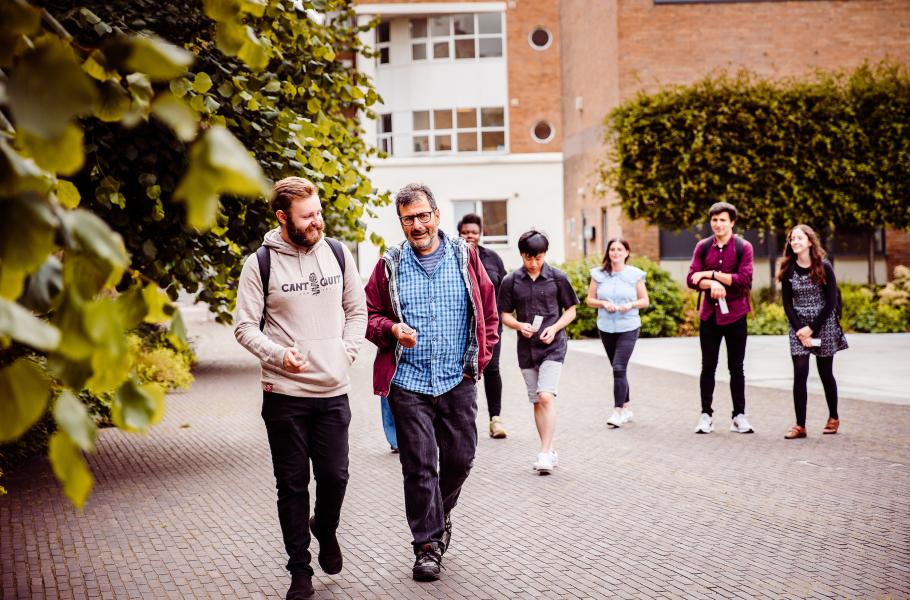
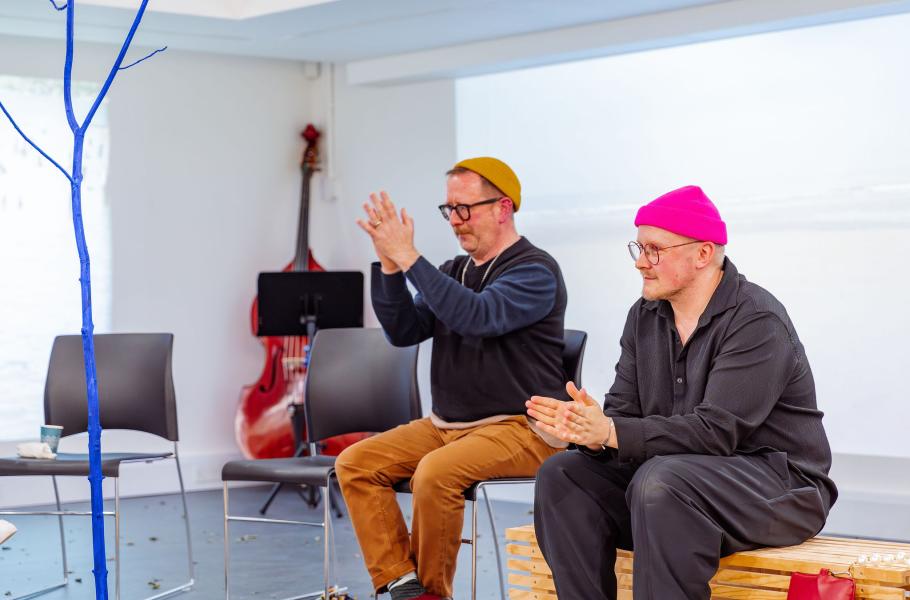
In January 2026, Lancaster Arts and Lowry welcomed a small group of artists, producers, academics, programmers and venue practitioners to the Nuffield Theatre at Lancaster Arts for a contemporary circus lab. Designed as a protected space for shared thinking rather than a place to reach conclusions, the day made room for listening, reflection, and open conversation about the development of the current and future eco-system of contemporary circus in the north of England.
The afternoon of discussion and exchange flowed into an evening work-in-progress performance by northern-based circus, magic and live art artist Tom Cassani. This event was opened up to invited members of the public and included a post-show discussion. His practice offered a powerful way of revisiting many of the questions and ideas that had surfaced earlier in the day.
Alice Booth, Producer at Lancaster Arts, wrote the following blog in response to the lab and performance.
Lancaster Arts and Lowry have both been programming and supporting contemporary circus for many years, working with shared artists, audiences and touring networks across the north and beyond. From dedicated seasons such as Lancaster Arts’ Women and Circus to presenting and supporting touring work over the past decade, both organisations have seen first-hand the strengths, distinctiveness and potential of contemporary circus practice in the region. At the same time, there has been a growing sense that across the north of England, opportunities for artists to take risks, develop boundary-pushing work, and be meaningfully supported over time remain uneven and fragile. Representation is inconsistent, platforms for experimentation are limited, and the infrastructure needed to nurture new work is often sporadic or absent. This contemporary circus lab was convened not because these issues are new, but because they felt pressing, and because both organisations recognised the value of addressing them together.
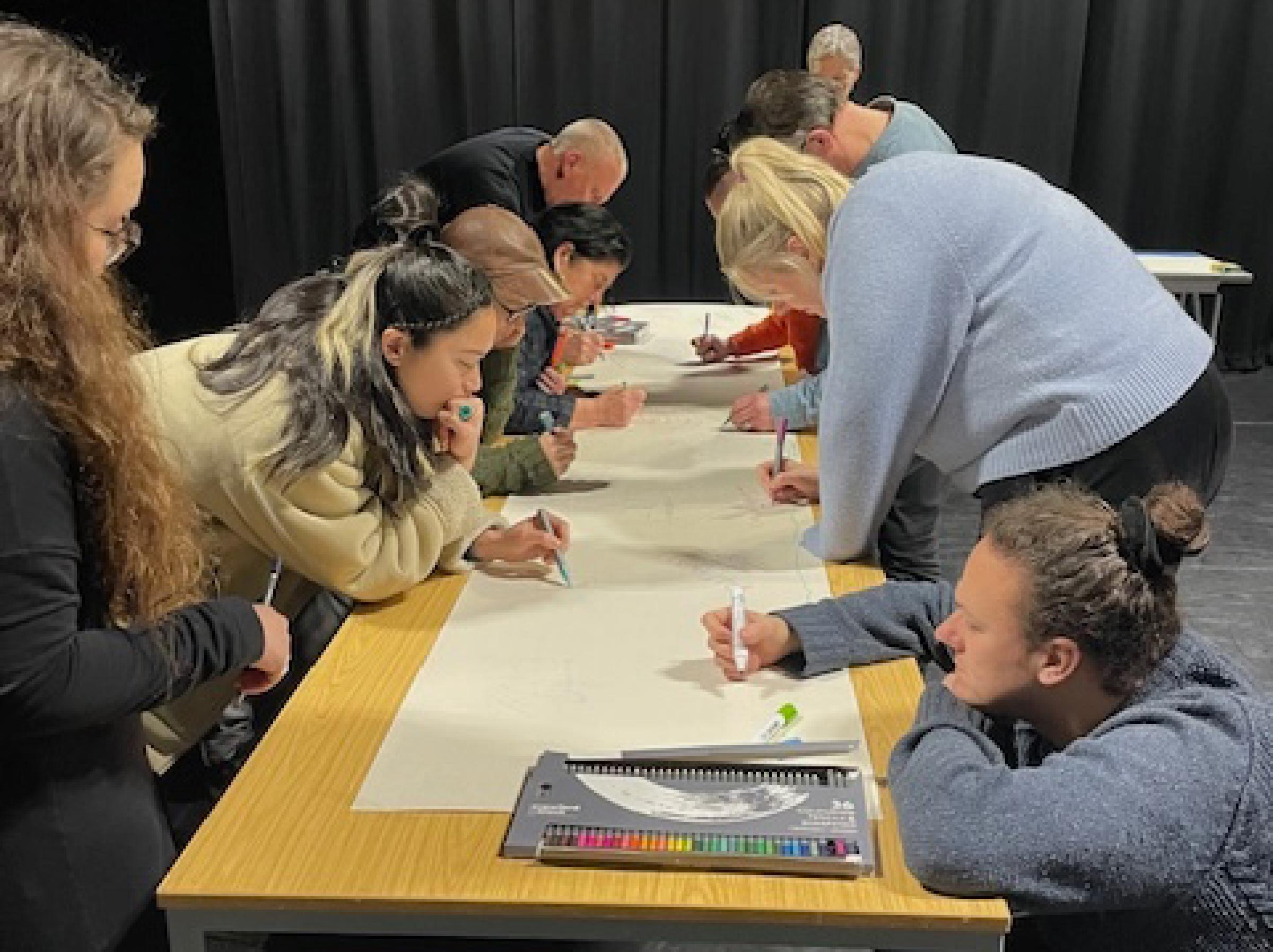
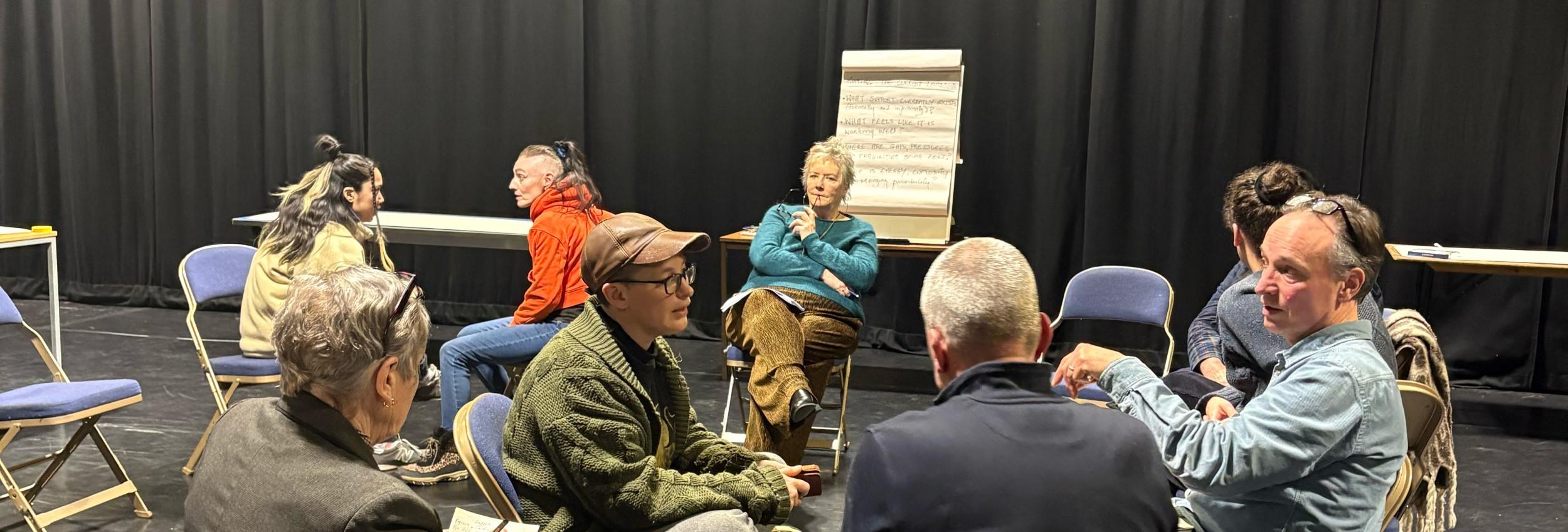
With this in mind, the afternoon was deliberately structured to resist premature conclusions. People had travelled across weather systems and geographies to arrive in the same room, despite disruption and difficulty, and there was a shared recognition that this time together had been consciously prioritised. It was clear from the outset that this was not a meeting designed to resolve everything. This was a lab in the truest sense: a protected conversation inside a performance venue, shaped by intention rather than outcome, with permission to speak personally rather than positionally. What mattered was not arriving at answers but paying attention to what surfaced when a small, mixed group took time to listen, mark paper, and sit with complexity together.
That structure shaped the composition of the room. Artists, programmers, academics, producers, and people who hold buildings all brought different pressures and different kinds of knowledge, and the conversation kept sliding diagonally across those perspectives. There was an insistence on anonymity, not to erase authorship, but to allow fragility. There was also a shared agreement, tested and occasionally bent, to try to leave funding outside the room, not because it is irrelevant, but because it so often flattens conversation before it has had time to deepen.
What emerged first was a recognition of what already exists. Not in a triumphant way, but almost with surprise. This mattered because so much of the conversation was shaped by a sense that contemporary circus in the north is under-seen, under-claimed, and too often discussed in terms of lack rather than potential. Training spaces, informal networks, scratch nights, teaching, community work, youth pathways, and hybrid venues surfaced slowly through shared memory. Someone described this existing support as humus*, unseen but essential. Others spoke about conversations, favours, shared equipment, late-night messages, and mutual care. Circus, it was noted, has always had to rely on itself, and that necessity has produced a deep culture of collaboration that is not always visible from the outside.
At the same time, fragilities were named. Affordable training space remains precarious everywhere. Progression pathways thin out just as people are becoming artists rather than students. There is a lack of producing capacity, particularly producers who understand both circus and the realities of venues. There are gaps in dramaturgical support, in marketing knowledge, in audience development, and in the ability to carry work forward once it has been scratched. Again and again, people returned to the sense that work often falls into a middle space, not ready to generate income, but too developed to be unpaid, held together by goodwill and exhaustion.
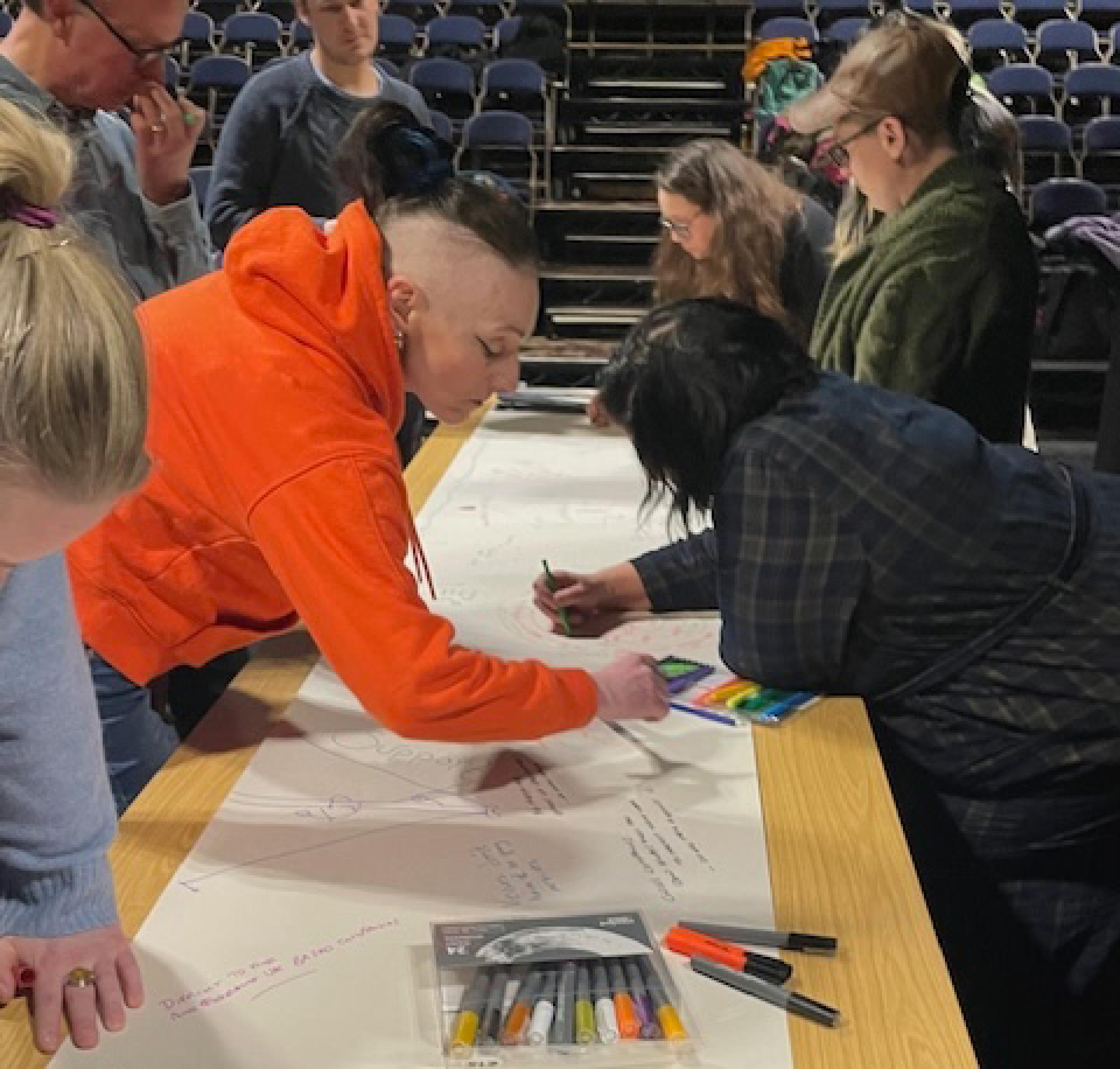
Geography threaded through everything. The north appeared not as a single place but as a shifting field of rural and urban, coastal and inland, with activity happening far beyond city centres. There was excitement in mapping what exists, but also frustration at how hard that information is to find, how much knowledge remains tacit, and how often assumptions are made about where culture happens. The idea of networks came up repeatedly, but always with a caveat: what is needed is not just connection, but granularity. Who do you contact. What does a space allow. What insurance is required. When can you be there. Who will understand what you are trying to do.
As the afternoon moved on, the conversation widened. People spoke about audiences, about scratch as a shared risk, about the importance of framing and expectation. Someone described greeting every audience member at the door to explain that their feedback mattered, that they were collaborators rather than consumers. Others spoke about the loss of social spaces around performance, the fireplaces where people once stayed, talked, danced, and met one another. Circus, it was suggested, does not currently have a reliable hearth, a place where people gather across generations and practices, and the absence of that shared warmth is felt.
Threaded through all of this were three ideas that landed with particular force. Ambition was named first, not in the sense of individual career progression, but as a collective challenge. Contemporary circus in the north, it was argued, is not ambitious enough. This was less an accusation than an invitation: to look honestly at what is being settled for, what has become normalised, and where caution has quietly replaced confidence. Ambition, in this framing, was not about becoming something else, but about claiming the value of what is already here and daring to ask what it could become. Memory followed. There was a sense that the sector often forgets its own histories, its cycles of growth and contraction, its previous attempts at networks and infrastructure. Without shared memory, it becomes harder to recognise patterns or to build on what has already been tried. Education completed the trio, not only formal training, but soft education, schools, audiences, and the stories told about what circus is and can be. If young people only encounter circus as spectacle or competition, something vital is lost.
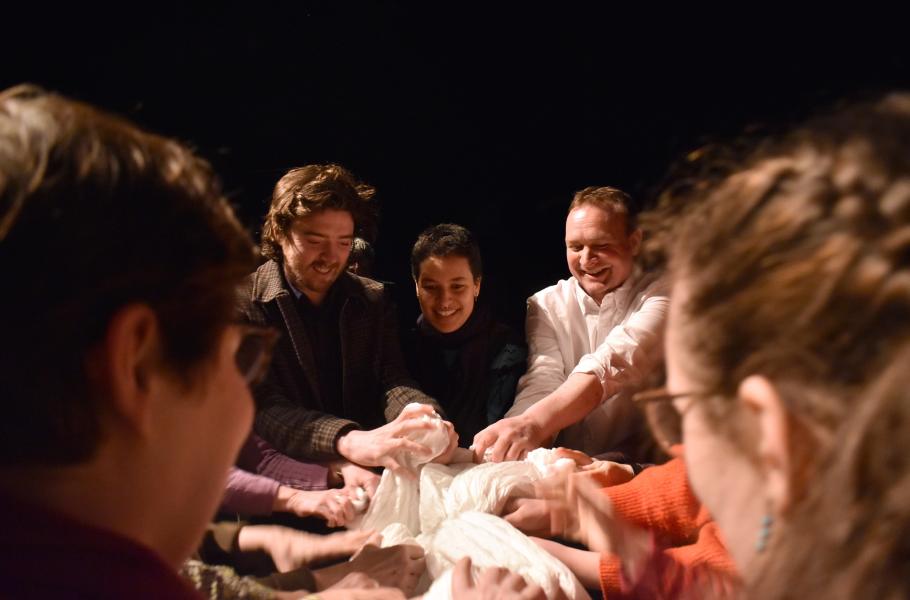
These ideas lingered as the room shifted again, chairs rearranged, swords cleaned, and an audience gathered close for Tom Cassani’s work-in-progress performance. The show contracted the space immediately. The audience was not asked to relax, but to lean in. Risk was named rather than hidden. At one moment, Tom spoke about his mother and said, “this is dangerous and I am doing it for you”, and the room felt the charge of that admission. Unease moved through the audience, followed by something like care. The oscillation between discomfort and safety became the engine of the piece.
What was striking, especially after the day’s conversations, was how clearly the performance embodied so many of the lab’s concerns, and how confidently it claimed its own terms. The intimacy was not accidental. By naming biography, by exposing process, by allowing clunky moments to remain visible, the work invited identification and, with it, complicity. The audience was not protected from complexity, but trusted with it, a gesture that felt quietly ambitious in itself. Movement and presence were repeatedly noted as strengths, as was the musical soundtrack, which shaped the emotional landscape with precision.
The post-show discussion was practical and generous. There was clarity about what the work needs next: time in a rehearsal room to iterate, to build and place custom props with a technician, to finalise lighting, soundtrack, and cue files, and to smooth transitions. These are not grand demands, but they are significant, requiring trust, resources, and the kind of support that is often hardest to access at this stage of development.
The conversation returned again to the value of iteration in front of audiences, to the importance of allowing work to grow rather than appear fully formed. There was recognition that the show’s distinctiveness is its strength, that its refusal to settle into easy comfort is precisely what makes it compelling. At the same time, there was an awareness that care is needed in how audiences are carried through that journey, how unease is framed, and how safety is re-established without dulling the edge.
What was learned was not a set of answers, but a set of tensions worth staying with. That support already exists,but is uneven and often invisible. That risk and care are not opposites, but partners. That development and presentation are too often separated, and that audiences are more generous, curious, and willing than we sometimes assume.
* the organic component of soil, formed by the decomposition of leaves and other plant material by soil microorganisms.
These questions extend beyond this moment and into Lancaster Arts’ wider programme this year, shaped by our theme of Dissent. In partnership with Lowry, and with the artists, producers, academics and practitioners who took part in the lab, dissent becomes a way of moving forward together: questioning existing structures, holding ambition, memory and education in view, and taking responsibility for what happens next. What that looks like is not yet fixed, but the intention is clear. Rather than offering conclusions, this feels like a shared commitment to turning attention into action, and to staying responsive to what is already here, and to what might still be possible. Watch this space.